Marketing for regenerative medicine operates at the intersection of complex science, tight regulatory rules, and deeply personal patient decisions. This article outlines the real obstacles clinics face, the digital channels that reliably attract qualified prospects, and the operational fixes that turn interest into booked visits. You’ll see how targeted SEO, precision paid ads, and education-first funnels build trust for nuanced procedures, and how qualification systems plus team training protect clinical outcomes while increasing appointment volume. We share practical examples—content themes, ad approaches, webinar funnels, and conversion playbooks—so clinical leaders and marketers can adopt proven, compliance-minded methods. We also introduce evidence-aligned capabilities a specialist medical marketing agency uses to produce measurable results and map those capabilities to the tactical choices clinics should make to capture more leads and better revenue.

 If you’re ready to improve lead quality and revenue while protecting clinical outcomes, our tailored solutions can help you scale responsibly. Schedule a discovery call today.

Think-Bullish-demo-call (1)

What are the core challenges when marketing regenerative medicine?

Marketing regenerative medicine brings together several tough constraints: treatments are new, patient decisions are costly and emotional, advertising is regulated, and the audience is niche but thorough in research.

Together these factors make acquisition costly and slow unless messaging, targeting, and follow-up are precisely calibrated to reduce friction and demonstrate outcomes. Providers must balance clear education with compliant language, and build funnels that guide skeptical prospects through clinical evidence and third-party validation. Those constraints shape channel selection, creative strategy, and qualification flows that favor appointment quality over raw volume and reduce wasted ad spend.

The single biggest hurdle is establishing credible trust signals early. Early trust-building content and concrete evidence shorten decision timelines and improve conversion—so tactics that address regulatory and credibility concerns become central to patient acquisition.

Common challenges clinics encounter include:

  1. Highly targeted, high-value audiences make broad campaigns risky and inefficient.
  2. Regulatory limits constrain outcome claims, complicating creative and landing copy.
  3. Long, emotionally charged decision journeys require education-first touchpoints to prevent drop-off.

Solving these challenges requires integrated solutions that align compliant messaging, precise audience targeting, and patient education across channels to boost lead quality and lower cost-per-booking.

How do trust and regulatory concerns affect patient acquisition?

Trust and compliance slow acquisition because marketers must avoid overstated claims while still communicating clear clinical value and realistic expectations. Clinics need to show data, clinician credentials, and authentic case stories to overcome skepticism without stepping outside advertising rules. That increases the demand for longer-form education and structured evidence presentation. Ads or pages that tout outcomes without clinical context risk compliance problems and disappointed patients, which damages reputation over time. Prioritizing third-party validation—peer-reviewed references, case reports, patient stories, and clinician bios—reduces friction while keeping messaging safe.

This regulatory environment favors gradual persuasion: webinars, FAQs, and condition-focused pages that require consistent follow-up and qualification to convert interest into appointments.

What common pitfalls should regenerative clinics avoid?

Many clinics unintentionally hurt lead quality through mistakes in targeting, messaging, and funnel design. Common missteps include overpromising results, using non-compliant outcome language, targeting broad demographics instead of in-market, in-pain cohorts, and failing to follow up quickly. Weak landing pages that don’t educate or answer top patient questions add friction and drop conversions. Treating paid ads as one-off promotions instead of parts of a multi-touch educational funnel often produces poor ROAS and limited lifetime value.

Avoiding these errors requires tight audience definitions, compliance-minded creative reviews, layered educational assets, and a qualification process that prioritizes readiness to proceed—changes that naturally lead to operational systems for faster lead handling and better scheduling.

How does Think Bullish’s AI Growth System change patient recruitment?

The AI Growth System combines automation and precise targeting to speed patient recruitment. It pairs immediate outreach with condition-specific targeting and funnel orchestration to lift qualified consultations. The system reduces lead fallout through rapid contact, improves qualification accuracy with structured triage, and routes only ready patients to clinical staff. It treats lead generation as both a targeting problem (find in-market, in-pain patients) and an operations problem (respond, qualify, educate, hand off). The result: more appointment-ready conversations and a clearer link between ad spend and revenue.

Below is a compact breakdown of the AI Growth System components and how they operate.

ComponentAttributeValue
AI Patient CoordinatorResponse timeImmediate outreach via call, SMS, and email with structured triple-qualification
Precision Ad TargetingAudience signalIn-market, in-pain behavioral and intent signals for condition-specific reach
Custom FunnelsOutcomeEducation-first journeys that lead to virtual seminars and consult bookings

What role does the AI Patient Coordinator play in qualification?

The AI Patient Coordinator handles the crucial first touch after a lead converts. It reaches out by phone, SMS, and email within minutes and runs a focused triage on condition severity, treatment motivation, and financial readiness. Automating this early screening reduces lead decay and raises show rates by sending only suitably qualified prospects to staff. It also provides structured intake data to human case managers, enabling quicker, more productive clinical handoffs and higher-quality consultations.

That rapid triage lowers operational load on clinic teams and pairs naturally with precision ad targeting that finds the right prospects to begin with.

How does precision ad targeting find in-market, in-pain patients?

Precision targeting layers signals—search intent, recent behavior, demographic overlays, and engagement with condition content—to surface users actively researching treatment options. Matching behavioral intent with creative that addresses pain points and avoids sensational outcome claims attracts higher-intent visitors who fit the clinic’s case mix. Performance is measured by cost-per-lead and conversion rates rather than impressions, enabling continuous optimization toward audiences that deliver booked consults. This audience-first approach focuses spend on users with actionable interest and improves downstream funnel efficiency.

Precision targeting completes the acquisition loop by feeding better leads into the qualification automation described above, improving the clinic’s ability to secure more converting appointments.

Which digital marketing strategies reliably drive lead generation?

Successful lead generation for regenerative medicine rests on three pillars: SEO and content for discovery and trust, paid advertising for immediate demand capture, and education-first funnels (virtual seminars, case studies) to warm complex buyers.

SEO creates long-term organic visibility around condition pages, patient journeys, and FAQs, while paid channels scale reach to in-market prospects. Educational assets bridge awareness and consultation by addressing safety, recovery, and clinician experience. Together these tactics form a multi-touch path that supports near-term bookings and long-term reputation growth.

The table below compares channel roles and the KPIs clinics should track.

ChannelAttributeTypical KPI / Metric
SEO & ContentTrust and organic discoveryTime-to-first-consult and organic conversion rate
Paid Ads (Precision)Immediate demand captureCost-per-lead and booked-consult rate
Educational FunnelsLead nurturing and qualificationWebinar-to-consult conversion and lead-to-patient LTV

This comparison helps clinics allocate budget between short-term demand and long-term discovery and underlines why integrated funnels matter.

When launching paid campaigns, clinics benefit from done-for-you creative and funnel execution that align messaging, landing pages, and follow-up with patient education. Ready-made video and image ads plus custom funnels shorten time-to-launch while keeping compliance and message consistency intact. Those operational supports let clinics scale without internal creative bottlenecks.

Core digital channels to prioritize include:

  1. SEO and content clusters focused on conditions and patient outcomes to build organic trust and lasting visibility.
  2. Precision paid advertising that reaches in-market audiences with compliant, education-first creative to drive immediate consult interest.
  3. Educational assets—virtual seminars and case-study sequences—that nurture complex decision journeys into booked consultations.

How can SEO and content educate and engage patients?

For regenerative medicine, SEO and content should center on condition pages, patient-journey narratives, FAQs, and third-party validation to reduce skepticism and support informed consent. Content clusters that connect technical explanations to real patient outcomes help both search engines and users find trustworthy information. Structured schemas and clinician bios boost credibility. Educational pieces—procedure explainers, recovery timelines, and cost guides—answer objections early and shorten the decision window. Technical SEO and local optimization capture high-intent searches while on-page trust signals raise organic conversion rates.

Those efforts feed educational funnels by producing informed prospects who are likelier to attend webinars and book consults, which precision ads can then accelerate.

What paid advertising approaches work best for stem cell and regenerative clinics?

Paid ads perform best when they use compliant, condition-focused creative that highlights alternatives to invasive procedures and features real patient journeys rather than promises. Start with short video or image creative that addresses patient concerns and send users to educational landing pages or virtual seminars instead of hard-sell pages. Landing pages should foreground FAQs, clinician credentials, and clear next-step scheduling. Ongoing A/B testing of creatives and pages, with regular compliance reviews, keeps campaigns effective and within regulatory limits.

A funnel that takes prospects from targeted ad to educational asset to consult scheduling improves lead quality and reduces wasted spend by matching messaging to the patient’s research stage.

How can practices convert leads and sustain growth?

Conversion and growth require operational readiness as much as smart acquisition: trained case managers, streamlined consent and scheduling workflows, and referral networks that bring complementary patients. Case manager training equips staff to handle clinical and financial conversations without losing prospects, while referral partnerships extend reach into specialties that feed high-intent patients. Measurement should focus on appointment show rates, consult-to-treatment conversion, and patient retention to grow lifetime value. Together these tactics turn marketing volume into durable practice growth.

Below is a simple mapping of conversion tactics and realistic outcomes clinics can expect within 3–6 months after disciplined implementation.

TacticAttributeExpected Outcome (3-6 months)
Case manager trainingClinical + financial qualification playbooksMeasurable improvement in consult-to-treatment conversion
Referral partnershipsOutreach & co-marketing with complementary providersSteady pipeline of higher-intent referrals
Post-treatment nurtureAutomated, personalized follow-upHigher retention and more referrals

Practical conversion actions clinics should adopt include:

  1. Train case managers in clinical qualification and financial counseling to reduce no-shows and increase treatment acceptance.
  2. Build referral partnerships with complementary providers to create predictable streams of qualified referrals.
  3. Deploy post-treatment nurture programs that turn satisfied patients into repeat customers and referrers.

What techniques increase patient conversion and retention?

Techniques that move the needle focus on personalization, clarity, and timing: personalized automated follow-ups, concise pre-appointment education modules, and structured post-treatment nurture sequences. Reminders plus short educational briefs reduce anxiety and improve show rates. Clear pre-appointment expectations about recovery and likely outcomes strengthen consent and satisfaction. Post-treatment sequences that ask for feedback, share recovery tips, and invite referrals keep patients engaged and more likely to recommend the clinic. Track KPIs like show rate, consult-to-treatment conversion, and referral volume so you can refine these techniques.

Delivering these systems requires the right tech stack and staff protocols, which dovetail with referral partnerships and case manager training as volume grows.

How do referral partnerships and case manager training support scalable growth?

Referral partnerships widen reach by connecting clinics to providers whose patients have overlapping needs, while structured case manager training preserves conversion quality as volume increases. A stepwise approach—identify partners, agree on mutually beneficial referral terms, and run joint educational events—builds reliable referral pipelines. At the same time, case manager playbooks standardize qualification questions, financial conversations, and follow-up flows to maintain conversion efficiency. Monitor referral ROI and conversion metrics to continuously optimize partner selection and training.

These external and internal investments create a scalable growth engine that complements targeted acquisition and strengthens long-term practice economics.

Why partner with Think Bullish for regenerative medicine marketing?

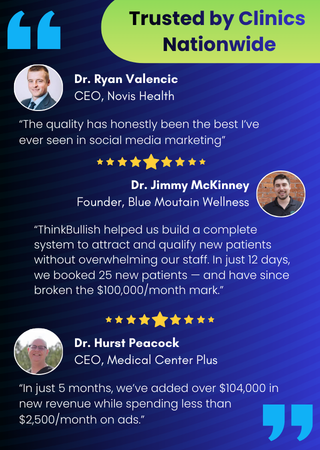
Think Bullish is a specialist medical marketing firm focused on lead generation and serving as an information hub for healthcare practices, including regenerative medicine. We combine AI-first qualification, precision targeting, and done-for-you creative and funnel execution to align acquisition with clinic workflows and compliance. Our performance-based pricing and geographic exclusivity reduce risk and concentrate effort on measurable outcomes. For clinics looking for more consistent, quality leads through coordinated targeting, automation, and education-first funnels, our model ties agency incentives to clinic results while protecting local market position.

Key value propositions Think Bullish brings to regenerative practices include:

  1. AI-first qualification: Automated multi-channel outreach and structured triage that lift lead-to-consult conversions.
  2. Done-for-you creative and custom funnels: Ready video and image ads plus compliant landing pages to speed campaign launches.
  3. Performance-based pricing with exclusivity: Outcome-aligned pricing and one-client-per-region to reduce direct competition.
These differentiators lower upfront risk and keep marketing focused on appointment quality and revenue—why many clinics choose partners that combine targeting, tech, and accountability.

What unique advantages set Think Bullish apart?

Think Bullish pairs AI-driven operational tools with full-service campaign execution designed for healthcare compliance and patient education. Our AI Patient Coordinator and Patient Recruitment Method (PRM) enable fast qualification and smooth handoffs, while precision ad targeting concentrates spend on in-market, in-pain audiences. Emphasizing done-for-you creative, custom funnels, and virtual seminar workflows lets clinics deploy education-first campaigns without building large internal creative teams. This integrated approach tackles trust, regulatory constraints, and complex patient journeys—helping clinics convert interest into visits more predictably.

Those service attributes combine into a system that prioritizes lead quality and clinic workflow efficiency.

How do performance pricing and exclusivity benefit clinics?

Performance-based pricing aligns our incentives with clinic outcomes by sharing risk and rewarding measurable success, lowering the barrier to test new channels and creative. Geographic exclusivity avoids direct agency conflict in local markets and protects a clinic’s awareness and search equity. Together, these models push the agency to optimize for lead quality and revenue rather than raw volume, creating a partnership that scales alongside clinical performance. Clinics focused on ROI and local stability will find these terms particularly useful when converting marketing spend into sustainable patient acquisition.

When evaluating partners, ask about outcome guarantees, exclusivity terms, and AI qualification workflows to see if an agency’s model matches your goals and risk tolerance.

Frequently Asked Questions

Why is patient education so important in regenerative medicine marketing?

Patient education is essential because regenerative treatments are complex and the decisions patients make are emotionally and financially significant. Clear, honest educational content—webinars, FAQs, condition pages—helps demystify procedures, addresses safety and recovery concerns, and builds confidence in your clinic. That trust leads to higher-quality inquiries and better conversion rates.

How can clinics measure whether their marketing is working?

Measure performance with KPIs that reflect real business outcomes: appointment show rates, lead-to-consult conversion, consult-to-treatment conversion, and patient retention. Track cost-per-lead and return on ad spend (ROAS) to evaluate financial efficiency. Regularly review these metrics to optimize channels, creative, and follow-up processes.

What role does social proof play in attracting patients?

Social proof—testimonials, case studies, peer-reviewed references—acts as a powerful trust signal. Real patient stories and credible evidence reduce skepticism and make prospects more comfortable taking the next step. Integrating social proof across ads, landing pages, and funnels improves credibility and conversion.

How should clinics use virtual seminars in their marketing?

Virtual seminars are a high-value touchpoint for educating complex buyers. Use them to cover treatment options, recovery expectations, and patient stories while allowing real-time Q&A. Seminars work well as lead generators and nurture vehicles: they capture contact data and move informed prospects closer to booking consults.

What are the benefits of automated follow-up systems?

Automated follow-up systems reduce lead decay and improve show rates by ensuring timely, relevant contact. They can deliver reminders, educational content, and personalized messages that keep prospects engaged. Automation also frees staff to focus on higher-complexity tasks, improving overall efficiency and conversion.

How can clinics stay compliant in their marketing?

Stay compliant by using factual, evidence-based language, avoiding unverified outcome claims, and running legal or compliance reviews of all materials. Focus on educational content that emphasizes safety and realistic expectations, and keep marketing teams trained on the latest regulatory guidance.

What strategies improve patient retention?

Improve retention with personalized follow-ups, post-treatment surveys, and ongoing nurture that provides recovery guidance and value. Loyalty incentives and referral programs can encourage repeat visits and word-of-mouth. Prioritize a consistent patient experience and regular communication to boost lifetime value and referrals.

Conclusion

Regenerative marketing done right combines clear education, precise targeting, and operational readiness. By using AI-assisted qualification, education-first funnels, and compliance-driven creative, clinics can raise appointment quality, shorten decision timelines, and grow sustainably. If you’re ready to improve lead quality and revenue while protecting clinical outcomes, our tailored solutions can help you scale responsibly.