Regenerative medicine clinics face a crucial budgeting choice: which metrics actually predict sustainable patient growth and true return on ad spend? This guide defines ROI for regenerative medicine marketing as the measurable link between your marketing investment and revenue from acquired patients, and explains why the right KPIs are the difference between spending and profitable scale. Read on to learn the market trends that justify investment, the core performance indicators that forecast revenue, how AI-enabled recruitment reshapes acquisition economics, practical tracking and analytics steps, and real-world outcomes that validate these methods. We focus on actionable calculations—CPA, CLV, ROAS—and practical optimizations that increase qualified leads and show rates. By the end, your team will have a clear framework to turn marketing signals into more leads, higher consult bookings, and stronger long-term ROI using automation, precision targeting, and data-driven optimization.

What Are the Current Trends and Growth Opportunities in the Regenerative Medicine Market?

Regenerative medicine is moving quickly from niche procedures to mainstream care as biologics, cell therapies, and orthobiologics gain approvals and wider clinical use. That shift is raising patient demand and expanding marketing opportunity. Growing investment and clearer reimbursement pathways have lifted total addressable market estimates, prompting more clinics to scale patient acquisition channels. Clinics that focus messaging on high-growth subsegments—like stem cell therapies, PRP, and orthobiologics—can capture early-adopter patients who are actively searching for non-surgical options. In practice, marketing budgets directed to digital channels and education-first funnels usually produce higher-intent leads and better conversion. Knowing these market dynamics helps you prioritize channels that feed qualified prospects and sharpen your patient targeting for more efficient acquisition.

How those macro shifts translate to clinic-level demand sets up the next section: projected market growth and the patient segments clinics should prioritize.

How Is the Regenerative Medicine Market Projected to Grow Between 2025 and 2034?

Forecasts for 2025–2034 point to multi-billion-dollar expansion as clinical adoption accelerates and new therapies reach the market. CAGR estimates differ by subsegment, but many show double-digit growth in key areas. Cell therapy and stem-cell services often outpace general orthopedic care, indicating faster scaling potential for specialized practices. For a mid-size clinic, even modest penetration of a growing serviceable market (SAM) can produce sizable consult increases: a 5% share of a growing SAM can double leads over several years when paired with optimized digital campaigns. Treat CAGR as a demand trajectory—not a guarantee—and align your marketing capacity to capture rising search and referral volume. Estimating TAM and SAM against realistic conversion funnels turns market growth into actionable patient acquisition forecasts.

The next section profiles the patient cohorts most likely to drive that growth and how to tailor messages that convert interest into consultations.

Who Is the Target Patient Profile for Regenerative Medicine Therapies?

Primary patient segments are active adults roughly 35–70 years old with musculoskeletal pain, sports injuries, or chronic joint issues who prefer non-surgical options and faster recovery. These patients usually prioritize functional outcomes, are willing to self-pay for elective procedures, and value avoiding long surgical downtimes; payer mixes commonly include both self-pay and insurance-covered adjunct services. Psychographically, they’re information-seekers: they research outcomes, ask for evidence, and respond to testimonial-rich, education-first content. Segment your creative into personas—acute-injury athlete, active retiree with degenerative pain, and surgical-avoidance candidate—to raise relevance and lead quality. Clear personas reduce wasted spend and improve lead-to-consultation rates.

With these profiles in mind, the next section defines the KPIs clinics must measure to translate leads into revenue.

Which Key Performance Indicators Define Marketing ROI in Regenerative Medicine?

Core KPIs for regenerative medicine measure both volume and value: Cost Per Acquisition (CPA), Customer Lifetime Value (CLV), Return on Ad Spend (ROAS), Lead-to-Consultation Rate, and Patient Show Rate give a full view of marketing efficiency and downstream revenue. CPA captures the cost to produce a booked patient; CLV projects revenue per patient over time; ROAS compares revenue attributed to ads against ad spend; lead-to-consultation measures funnel efficiency; and show rate tracks how many scheduled consults actually attend. Monitoring these metrics together shows whether higher spend is generating profitable patient cohorts or only increasing unqualified leads. Below is a quick-reference table with formulas and example benchmarks you can use immediately.

Intro to the KPI reference table: this table lists core metrics, a compact formula, and a practical benchmark clinics can use as a starting point.

MetricFormulaExample Benchmark
Cost Per Acquisition (CPA)Total Marketing Spend ÷ New Patients$500–$2,500 per patient (depends on treatment type)
Customer Lifetime Value (CLV)Avg Revenue per Visit × Visits per Year × Years Retained$8,000 (example for repeat procedures)
Return on Ad Spend (ROAS)Revenue Attributed to Ads ÷ Ad Spend3:1 (300%) target for profitable growth
Lead-to-Consultation RateConsult Bookings ÷ Qualified Leads20–35% (funnel dependent)
Patient Show RatePatients Who Attend ÷ Booked Consults70–90% (high-show target)

Use this table to calculate ROI and to work backward from revenue targets to required lead volume each month.

After laying out the metrics, the next subtopic shows how to calculate CPA in practice and why it matters for budgeting and scale.

How Do You Calculate Patient Acquisition Cost and Why Is It Important?

Patient Acquisition Cost (CPA) = total marketing spend ÷ new patients acquired over the same period. It ties marketing dollars directly to revenue outcomes and tells you how much you can sustainably pay to acquire a patient. Example: $20,000 marketing spend ÷ 20 new patients = $1,000 CPA. Reducing CPA improves margin and enables scaling; tactics include better landing-page conversion, tighter audience targeting, stronger lead qualification, and faster follow-up to cut lead drop-off. CPA must be evaluated alongside CLV—if CLV comfortably exceeds CPA, acquisition is profitable. If not, you either lower CPA or raise per-patient value. Monitor CPA weekly and align it to CLV thresholds for predictable growth.

Next: why CLV matters and how it sets acquisition limits.

What Is Customer Lifetime Value and Its Role in Marketing Success?

Customer Lifetime Value (CLV) estimates the net revenue a clinic expects from a patient over the relationship and defines the maximum sustainable CPA. A straightforward CLV example: $2,000 per procedure × 2 procedures/year × 3 years = $12,000 gross CLV before costs. CLV informs acquisition budgeting: with a 40% target margin, you can allocate up to ~60% of CLV to acquisition and delivery while meeting profit goals. Increasing CLV—via retention programs, upsells, maintenance packages, or higher-value services—raises your allowable CPA and supports more aggressive growth. Mapping CLV to acquisition targets ensures your marketing investments grow revenue rather than erode profitability.

With KPI mechanics in place, the next section explains how AI-driven recruitment shifts these economics by improving lead quality and operational efficiency.

How Does Think Bullish’s AI-Powered Patient Recruitment Method Enhance ROI?

AI-enabled recruitment boosts ROI by automating qualification, speeding up engagement, and prioritizing high-intent prospects—reducing wasted ad spend and lifting funnel conversion. The Patient Recruitment Method (PRM) pairs precision ad targeting, short-form funnels, intake applications, virtual seminars, and automation to increase lead-to-consultation rates and volume of pre-qualified, pre-paid patients. Faster follow-up and automated pre-screening shorten time-to-book and cut lead drop-off, which raises show rates; these operational gains lower CPA and improve ROAS. The outcome: less emphasis on raw lead volume and more on predictable, revenue-generating patient workflows that scale ad investment efficiently.

Intro to mapping table: the table below links AI features to their function and expected KPI impact so you can see how technology produces measurable improvements.

AI FeatureFunctionMeasurable Impact on KPI
AI Patient Coordinator™24/7 engagement, pre-screening, nurtureHigher qualification rate, faster booking (↓ CPA)
Precision Ad TargetingAudience refinement and lookalike modelingIncreased lead intent, improved ROAS
Short-Form FunnelsRapid qualification via micro-conversionsBetter lead-to-consultation rates
Intake ApplicationsStructured intake data captureHigher show rates and better CLV forecasting
Virtual SeminarsEducation-driven lead generationGreater trust, higher consult conversion

This mapping demonstrates how automation components improve CPA, ROAS, CLV, lead-to-consultation, and show rate.

Next we describe the AI Patient Coordinator™ and how it materially improves lead qualification and conversion.

What Is the AI Patient Coordinator™ and How Does It Improve Lead Qualification?

The AI Patient Coordinator™ is an always-on conversational layer that pre-screens, educates, and schedules prospects—turning interest into consults with minimal manual work. It shortens average response time (a common cause of lead loss), captures structured intake data for priority routing, and runs conditional booking flows that surface high-value leads. Automated reminders and optional prepayment flows reduce no-shows. The result: more consults booked and attended for the same ad spend, cleaner case management, and improvements in both CPA and show rates. That’s how automation changes patient acquisition economics in favor of scalable profitability.

Building on automated qualification, the next section explains targeting and funnel tactics that extract higher intent from ad spend.

How Do Precision Ad Targeting and Funnel Optimization Drive Better Marketing Results?

Precision targeting narrows audiences to high-intent cohorts using behavior, demographics, and lookalike signals—cutting wasted clicks and improving ROAS by increasing qualified leads per ad dollar. Funnel optimization leans on short-form educational content, intake applications, and clear CTAs to quickly distinguish eligible patients from casual browsers. Try this A/B test: persona-focused creative versus broad awareness creative, then compare lead-to-consultation rate and CPA—the persona-targeted ads should lower CPA and lift conversion if targeting is right. Continuous funnel testing plus data-driven lead scoring ensures budgets acquire patients with higher CLV and show propensity. Together, targeted ads and tight funnels reduce CPA and increase lifetime revenue per patient.

With AI and targeting covered, the next major section gives best-practice steps clinics can implement to operationalize tracking and improvement.

What Are the Best Practices for Implementing and Tracking Regenerative Medicine Marketing ROI?

Start with clear goals, mapped KPIs, and a measurement stack that attributes leads to channels and tracks outcomes through to revenue and retention. Build a measurement plan that links ad-platform events to CRM consult bookings and final patient revenue—this is essential to calculate true ROAS. Set a reporting cadence: weekly for lead volume and CPA, monthly for ROAS and CLV trends, and quarterly for attribution reviews and strategic shifts. Maintain data hygiene—consistent UTM tagging, standardized CRM intake fields, and disciplined campaign naming—so analytics produce reliable insights. These practices let clinics turn marketing activity into predictable growth management can forecast.

The list below summarizes immediate implementation priorities to start measuring ROI effectively.

  1. Map revenue goals to KPIs and set CPA/CLV targets.
  2. Configure UTM and event tracking across ads, landing pages, and the CRM.
  3. Standardize intake fields to capture source, intent, and prequalification status.

Completing these steps sets you up to choose the right KPIs and tools, which the following H3 sections cover.

How to Set Clear Marketing Goals and Select Relevant KPIs?

Define a revenue or patient-volume goal for a specific period, then reverse-engineer required consults, leads, and ad spend using your target CPA and conversion rates to create a practical acquisition plan. Example: 20 new patients per month at $1,500 CPA requires $30,000 monthly acquisition spend; you then forecast required lead volume based on lead-to-consultation and show rates. Use a simple goal → KPI → metric mapping: revenue target → number of new patients → CPA, CLV, ROAS, lead-to-consultation. Build conservative and stretch scenarios to test sensitivity to CPA and conversion changes. Document and review these mappings each reporting cycle to keep targets realistic and aligned with capacity.

After goals, pick the analytics tools and configurations that support those KPIs.

Which Data Collection and Analytics Tools Optimize Campaign Performance?

An effective analytics stack pairs ad-platform tracking and GA4 events with a CRM that captures intake and revenue outcomes to enable end-to-end attribution from click to paid patient. Configure CRM fields to capture source, campaign, intake answers, prequalification flags, booking status, and revenue so you can run cohort analysis by campaign and creative. Use UTM parameters consistently and send conversion events from landing pages and booking systems into GA4 and ad platforms for accurate ROAS. Regularly export CRM data for cohort CLV analysis and feed it into dashboards that visualize CPA, ROAS, lead-to-consultation, and show-rate trends. These practices ensure decisions are based on end-to-end economics rather than top-of-funnel metrics alone.

With measurement and tools in place, the final major section shows real-world outcomes from clinics that implemented these optimizations.

What Real-World Success Stories Demonstrate Effective ROI in Regenerative Medicine Marketing?

Case summaries backed by data show how focused KPI tracking, AI-enabled qualification, and funnel optimization turn marketing spend into meaningful revenue gains. Clinics that shift to precision targeting and automated intake typically see uplift in lead quality, higher consult conversion, and improved show rates—results that compound into material revenue growth. Performance-based engagements and guarantees can de-risk investment by tying fees to outcomes like booked consults or revenue thresholds. Below is a concise case outcome table with typical result types and the timeframes over which they occurred.

Client TypePeriodRevenue / ROI Outcome
Regenerative clinic (scaled PRM)6 monthsSignificant revenue uplift; multi-month pipeline growth
Clinic with performance-based contract3–6 monthsRisk-shared pricing with guaranteed thresholds (example: $150K guarantee)
Clinic using AI qualification2–4 monthsHigher show rates and more pre-qualified, pre-paid patients

These outcomes are representative of results when clinics implement precision targeting, automated qualification, and a regular optimization cadence.

Next, we summarize how Think Bullish’s approach has driven measurable clinic growth and which metrics prove the impact of AI-driven acquisition.

How Have Think Bullish Clients Achieved Significant Revenue Growth and ROI?

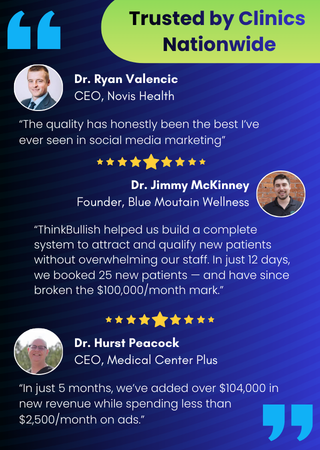
Think Bullish combines its AI Growth System and Patient Recruitment Method (PRM) into an integrated approach—automation, precise targeting, and funnel design—to accelerate patient revenue. Clients on performance-based pricing and PRM workflows report faster topline gains through increases in pre-qualified and pre-paid patients and improved show rates; some programs are framed with ambitious targets, like adding seven figures of revenue over a defined period. The mechanisms behind those results are consistent: better lead qualification, fewer administrative bottlenecks, and predictable intake volume from targeted campaigns. By aligning fees to outcomes and optimizing for high-intent cohorts, clinics can scale acquisition while protecting unit economics.

This leads to the final subsection, which lists the metrics that show AI-driven success.

What Metrics Showcase the Impact of AI-Driven Patient Acquisition Strategies?

Key metrics that indicate AI impact include reduced average response time to inquiries, higher share of pre-qualified leads, improved lead-to-consultation rates, increased show rates, and stronger ROAS—each directly tied to revenue improvement. For example, halving response time can meaningfully increase booking rates; automating intake raises the percentage of consults that arrive with completed forms and prepayment, improving show rates and cash flow. Compare cohorts before and after AI to isolate lift from automation versus creative or channel changes. Track these metrics alongside CLV and CPA to confirm automation is producing sustainable, profitable growth rather than short-term volume gains.

These measurable signals help clinics attribute revenue gains to AI-enabled workflows and refine investment for ongoing expansion.

  1. Action list: If you’re implementing these ideas, start with three immediate actions.
  2. Measurement list: Then create three reporting views to monitor performance.
  3. Optimization list: Finally, run three experiments to improve conversion.
  4. Immediate Actions: Map revenue goals to KPIs, instrument UTM/CRM, and deploy an intake application to capture qualified leads.
  5. Reporting Views: Weekly CPA dashboard, monthly CLV/ROAS cohort report, and a show-rate trend view for appointment performance.
  6. Experiments to Run: Persona-targeted creative vs. broad creative A/B test, response-time reduction pilot (automated vs. manual), and a prepayment incentive test to measure show-rate impact.
These steps create a tactical sequence—plan, measure, iterate—that connects investment to outcomes and steadily improves ROI.

This article offers a practical framework to assess and maximize marketing ROI for regenerative medicine practices by combining market context, KPI discipline, AI-enabled workflows, and concrete measurement steps that produce more leads, better-qualified consults, and sustainable revenue growth.

Frequently Asked Questions

What are the common challenges clinics face in measuring ROI for regenerative medicine marketing?

Clinics commonly struggle with fragmented tracking and inconsistent metrics. Without standardized data collection and a mapped customer journey, it’s hard to attribute revenue to specific channels. Poor data hygiene and limited integrations between ad platforms and CRMs create blind spots that prevent accurate optimization and confident budget decisions.

How can clinics improve their lead-to-consultation rates?

Improve funnels and qualification: use education-first creative, clearer CTAs, and brief intake applications that surface intent. Automate initial screening and follow-up to cut response times, and run A/B tests on messaging and offers. Together, these moves boost the percentage of leads that convert to booked consults.

What role does patient education play in regenerative medicine marketing?

Education is central—patients in this space seek evidence and outcomes. Clinics that provide clear, evidence-based content via blogs, webinars, and social proof build trust and shorten decision time. Educated prospects convert at higher rates because they understand benefits, risks, and expected recovery.

How can clinics effectively utilize social media for patient acquisition?

Use social media to combine targeted paid campaigns with organic educational content and testimonials. Paid ads let you reach specific demographics; organic posts and live Q&A sessions build credibility. Mix short-form education with proof points to attract high-intent traffic to conversion-focused funnels.

What are the benefits of using performance-based marketing contracts?

Performance-based contracts align incentives between clinic and agency by tying fees to outcomes like booked consults or revenue milestones. They reduce upfront risk for clinics, encourage continuous optimization from agencies, and increase transparency around what’s being delivered.

How can clinics ensure they are targeting the right patient demographics?

Start with market research and CRM segmentation to build clear personas. Use analytics to identify which cohorts convert and have higher CLV. Iterate targeting criteria based on campaign performance and patient feedback to keep acquisition focused on the most valuable audiences.

What strategies can clinics implement to enhance patient retention and increase CLV?

Boost retention with personalized follow-ups, maintenance packages, and coordinated care plans. Deliver exceptional patient experiences and use reminders, loyalty incentives, and outcome tracking to encourage repeat visits. Solicit feedback and act on it—retention lifts CLV and expands your allowable CPA for profitable growth.

Conclusion

Measuring and optimizing ROI in regenerative medicine isn’t speculative—it’s operational. By tracking the right KPIs, adopting AI-enabled qualification, and running disciplined measurement and experimentation, clinics can grow patient volume profitably. Use these insights to sharpen your marketing, improve intake efficiency, and scale acquisition with predictable economics. Explore our resources and start applying these steps to elevate your practice’s growth.

Want to get started with regenerative medicine marketing? Schedule a call with our expert team.